


For a business owner, an exit is rarely just a transaction. It's a season change, one where a business that has generated income for years becomes something else entirely: a pool of value that has to support the life that comes next.
Aligning that transition with long-term goals tends to come down to three things: understanding what the business might realistically net you, choosing a deal structure that fits your timeline, and building a plan that doesn't lean on any single outcome. Here's how we think through each one.
What Changes When You Step Away
Before an exit, income for a business owner is rarely just a paycheck. It's often a blend of wages, distributions, and flexibility that's built into how the business runs, things like expense policies or discretionary spending that quietly reduce what comes out of pocket personally.
After an exit, that engine changes shape. Retirement income tends to come from investable assets, any retained interest in the business, real estate, and other savings, rather than from daily decisions you're used to making. That shift can feel freeing. It can also mean letting go of levers you've relied on for years, like accelerating distributions or taking on more work to close a gap.
This is part of why price, while important, isn't the whole planning question. The deeper question is whether the proceeds and any ongoing payments create a cash flow pattern that fits how you want to live, and how much involvement you still want to carry.
It can be an emotional adjustment, too. Owners are often wired to solve problems through action. In retirement, some things, like market cycles or the timing of large expenses, don't respond to effort the same way. A thoughtful plan won't remove that uncertainty, but it can help clarify which parts of it you're comfortable living with.
What Your Business Might Actually Contribute
Valuation tends to get discussed as a single number. Retirement planning works better when that number is treated as a range, and when spendable proceeds are calculated separately from the sale price itself.
From a valuation number to net proceeds. It's easy to picture a sale price and mentally spend the whole thing. In practice, several categories tend to reduce what's actually available:
Transaction costs and professional fees tied to the sale
Debt or obligations settled at closing
Taxes triggered by the sale, depending on entity type and structure
Working capital adjustments, holdbacks, or escrow
Contingent or deferred payments tied to performance conditions
Reserves for post-sale commitments, such as warranties or transition support
Once proceeds are modeled in net terms, it becomes easier to connect the exit to real lifestyle decisions. A plan built on the gross number can look strong on paper and feel much tighter in practice. A plan built on net resources tends to surface trade-offs while there's still time to adjust for them.
Why timing matters as much as price. Two owners can sell at similar prices and land in very different places, because the cash arrives on different terms. Timing shapes when you can diversify, when portfolio income can begin, and how flexible your retirement date really is. One helpful exercise: run the plan assuming a later exit, a lower valuation, or proceeds paid over time. If any of those scenarios strain the plan, that's worth a closer look.
How Deal Structure Shapes the Retirement Paycheck
Exit structure has a real effect on how retirement income actually arrives. Some structures favor immediate liquidity. Others trade liquidity for a smoother transition, a higher total, or a business that stays in familiar hands. None is inherently the right choice. What matters is how each one fits your timing, your comfort with uncertainty, and how much business-related risk you want to carry forward.
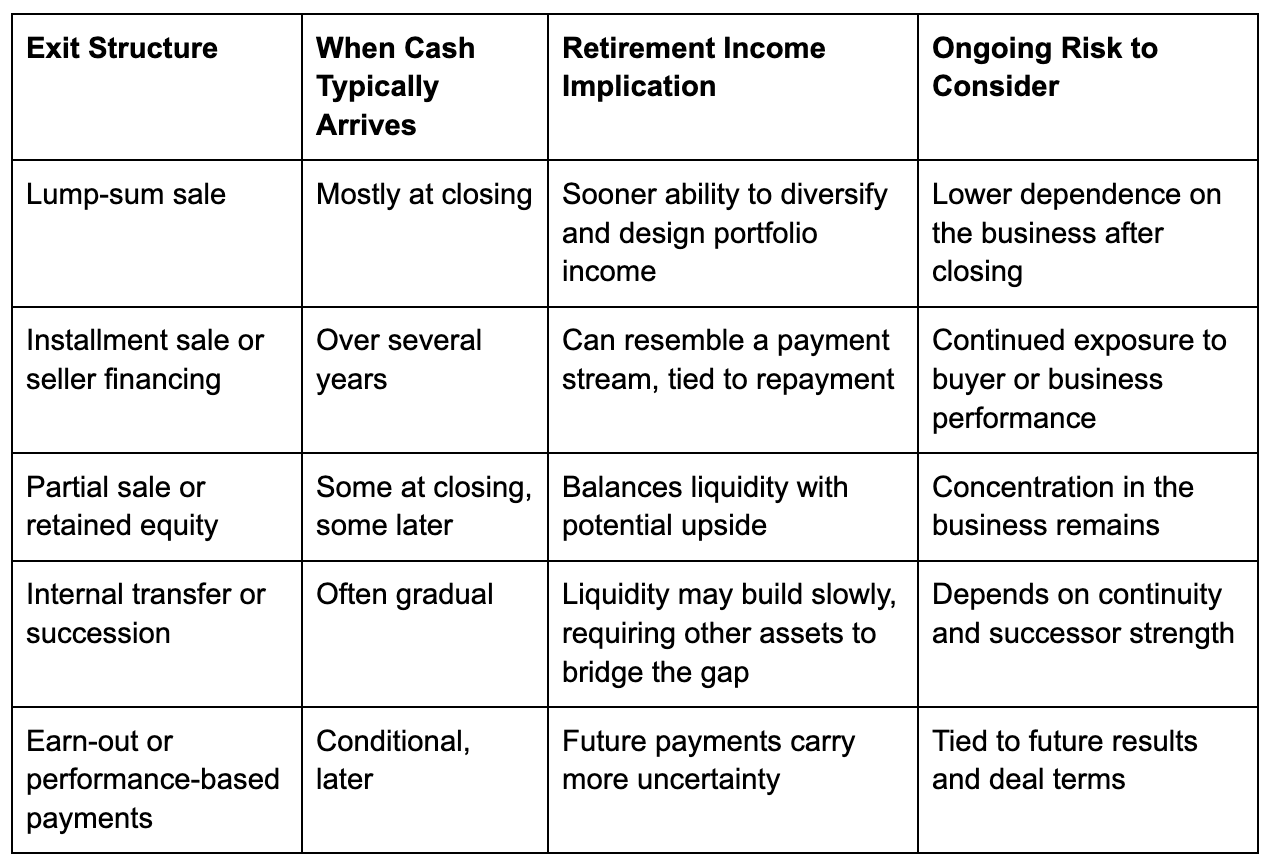
A retirement-focused look at structure usually comes down to a few honest questions: how soon you want income to start, how much early variability you can live with, and whether you're looking for a clean break or a longer transition. If a plan assumes immediate liquidity but the deal involves staged payments, something else in the plan may need to flex, such as building more assets outside the business or holding a larger cushion.
Turning Proceeds Into a Plan That Can Support You
After an exit, many owners notice a sudden shift in concentration. Before the sale, the business was the dominant asset, one they understood deeply. After, much of that wealth may be liquid and invested, exposed to markets and inflation in a different way than before.
Diversification is the practical response. It isn't about complexity for its own sake. It's about reducing reliance on any single outcome, so retirement doesn't depend on one company, one buyer, or one set of conditions staying favorable.
Thought of this way, a retirement paycheck becomes something you design: reliable sources for core spending, liquidity for near-term needs, and flexibility built in for the years markets are less cooperative.
It's also worth noting that retirement doesn't have to mean stepping away from earned income entirely. Some owners choose consulting, board work, or part-time involvement after a sale. That can ease early pressure on the portfolio, though it tends to work best when treated as optional rather than something the plan depends on.
And finally, these decisions rarely stand alone. Philanthropy, family support, and legacy goals often shape how much liquidity to hold, how to plan for irregular giving, and how risk is defined in the first place.
Frequently Asked Questions
How early should I start planning my exit if I want it to fund retirement? Many owners find a multi-year runway helpful, since retirement planning depends on more than the eventual sale price. Time can allow for building assets outside the business, clarifying spending expectations, and evaluating structures without rushing. Even with an uncertain exit date, modeling net proceeds and timing scenarios can clarify what the business needs to accomplish.
Can I retire on my business sale alone, or should I build other assets first? Some owners lean primarily on sale proceeds, while others prefer a broader base. Building resources outside the business can ease the pressure on the deal to land perfectly on both timing and price, and it can offer more flexibility if part of the purchase price is paid over time or tied to performance.
What happens if my business sells for less than I expect? This is where planning in ranges tends to help. If the price lands lower, the levers most often available are retirement timing, spending flexibility, and the role other assets play. A clear view of net proceeds can make those adjustments more straightforward.
Is it better to take one lump sum or payments over time? A lump sum tends to support faster diversification and earlier portfolio design. Payments over time can create a familiar cash flow feel, but often come with more counterparty and performance risk. The more useful question is which structure fits your desired retirement start date and your comfort with variability in the early years.
How do I think about risk once my wealth is in a portfolio instead of my business? The risk changes shape. Instead of operating risk tied to one company, you may face market volatility, inflation, and sequence risk early in retirement. Diversification, liquidity planning, and a clear split between core and discretionary spending can help manage those risks without needing to predict the next market cycle.
Should I keep a role in the business after the sale? Some owners stay involved because they enjoy it, want to support the transition, or prefer a gradual shift. Earned income can ease early reliance on the portfolio, though it may also keep you tied to business outcomes depending on the arrangement. If staying involved is part of the plan, it's worth clarifying early whether that income is a bonus or something the plan actually depends on.
Where To Go From Here
Thoughtful retirement planning for a business owner connects the value you've built to the life you want after you step away. It translates equity into net, investable resources, then looks at whether the timing and structure of those proceeds can produce the cash flow your next season actually calls for.
If it would help to pressure-test your own scenarios, or think through how your exit and retirement goals align, we'd welcome the conversation.
Contact Us Today To Design Your Plan